
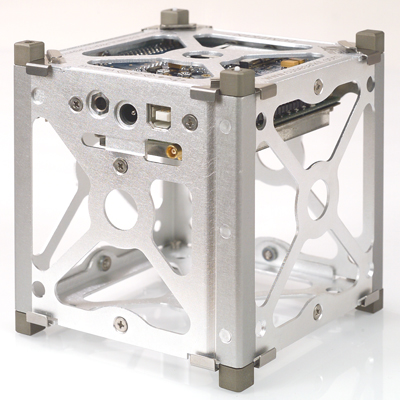
Think inside the box ...
Planning a CubeSat misson? Your first decisions might be the most critical.
Compared to traditional multi-million-dollar satellite missions, CubeSat projects have the potential to educate the participants and implement successful and useful missions in science and industry at much lower costs.
CubeSat payloads and experiments are often new and unique, and project timelines are typically 9-24 months from inception to launch. Since launch opportunties are scheduled well in advance, it's critically important that a CubeSat project adhere to its schedules and stay on time and under budget.
CubeSat missions still require considerable planning and many man-hours of work to maximize the chances for success. By employing as much standardization as possible you can concentrate on your project's mission-specific goals. By making use of as many off-the-shelf commercial and freely available tools and components in the construction of the nanosatellite, you'll save time and money.
Through its comprehensive and flexible hardware and software design, Pumpkin's space-proven CubeSat Kit will help achieve success in your CubeSat mission. Now in its fourth generation and with over 150 delivered to customers since 2003, Pumpkin's CubeSat Kit is the defacto standard in the CubeSat universe, with compatible product offerings from Pumpkin and third parties.
The CubeSat Kit pricelist is available online for your budgetary considerations.
The CubeSat nanosatellite standard
The 10x10x10cm, 1kg ("1U") CubeSat standard has evolved to become the basis for one of the most widely accepted families of nanosatellite designs. Originally proposed by Professor Bob Twiggs at Stanford University, it and its companion P-POD deployer were later developed in conjunction with Professor Jordi Puig-Suari at California Polytechnic University San Luis Obispo. Despite its emphasis on simplicity and low costs, the CubeSat standard address all the critical issues required for a successful mission, from the external mechanical dimensions of the nanosatellite, to the CubeSat-specific P-POD launcher, to test and integration procedures, etc.
Maximum flexibility through integrated design
Conforming fully to the CubeSat specification, Pumpkin's CubeSat Kit is an affordable off-the-shelf hardware and software development and deployment solution that includes:
- Complete, finished and ready-for-launch CubeSat structure (in 0.5U, 1U, 1.5U, 2U or 3U size) with high strength, low mass, and exceptionally large internal volume
- Both a Development Board (DB) + Pluggable Socketed Processor Module (PSPM) for in-lab development and testing, and a separate Motherboard (MB) + Pluggable Processor Module (PPM) for the actual Flight Model
- Low-power, high-performance electronics based on your choice of PPM, using:
- TI's 16-bit MSP430 ultra-low-power microcontroller (PPM A1|A2|A3)
- Silicon Labs® C8051 8-bit mixed-signal MCU (PPM B1)
- Microchip® PIC24 16-bit high-performance microcontroller (PPM D1, PPM E1)
- Microchip® dsPIC33 16-bit digital signal controller (PPM D2)
- Pumpkin's space-proven multitasking Salvo Pro RTOS software
- Pumpkin's CubeSat Kit software libraries
- Pumpkin's processor-specific software libraries
- HCC-Embedded's EFFS-THIN FAT file system library for use with the CubeSat Kit's SD card socket
- Example projects
- Plug-in modem / transceiver support and built-in USB 2.0
- USB debug / Flash emulation tool (FET) for programming and debugging
- Power supplies, programming adapters, cables and tools
All you need is a PC and a C compiler certified for use with the CubeSat Kit to begin work ...
A total system approach
The CubeSat Kit System Chart illustrates how the design of the CubeSat Kit's structure, electronics and software all emphasize flexibility to accommodate a myriad of potential CubeSat missions. We invite you to become acquainted with the CubeSat Kit, and to learn how it can jumpstart your CubeSat mission.